IQ Basics
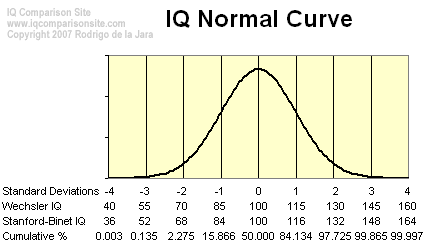
Graph drawn in Excel using the NORMDIST function.
What is intelligence? The definition I like is that intelligence
is "the ability to learn or understand or to deal with new or trying situations
... also : the skilled use of reason" (7). I have heard some people
misuse the word smart to mean knowledgeable. That is like confusing velocity
with distance. That one can lead to the other does not mean that they
are the same thing, especially in societies where education is not universal.
I.Q. = Intelligence Quotient
Originally, "IQ" tests were created to be able to identify children
who might need special education (1).
Binet's test included varied questions and tasks. The tasks even included
unwrapping a piece of candy and comparing the weights of different objects (4)!
To relate the mental
development of a child to the child's chronological age the IQ was
invented. IQ =
(MA/CA)
* 100. The intelligence quotient was equal to 100 times the Mental Age divided
by the Chronological Age. For example, if a certain child started reading, etc., at
the age of 3 (CA) and average children start reading, etc., at the age
of 6 (MA), the child would get an IQ score of 200. (Such a score is
very, very rare). Since people wanted to also use IQs for adults,
that formula was not very useful since raw scores start to level off around
the age of 16 (2).
Thus the deviation IQ replaced the
ratio IQ. It compares people of the same age or age category and assumes
that IQ is normally distributed, that the average (mean) is 100 and that the
standard deviation is something like 15. (IQ tests sometimes differ in their standard deviations).
What is a standard deviation (SD)? Simply put, the standard
deviation is a measure of the spread of the sample from the mean. As
a rule of thumb, about 2/3 of a sample is within 1 standard deviation
from the mean. About 95% of the sample will be within 2 standard deviations
from the mean (3).
With the standard deviation and a mean, you can calculate
percentiles. Percentiles tell you the percent of people that have a score
equal to or lower than a certain score.
High IQ societies ask
for certain percentile scores on IQ tests for you to be eligible to join them. Mensa asks for scores at the 98th percentile or higher. For a list of the selection
criteria of other societies, click
here.
There have been various classification systems for IQ.
Terman's classification was (6):
| IQ Range |
Classification |
| 140 and over |
Genius or near genius |
| 120-140 |
Very superior intelligence |
| 110-120 |
Superior intelligence |
| 90-110 |
Normal or average intelligence |
| 80-90 |
Dullness |
| 70-80 |
Borderline deficiency |
| Below 70 |
Definite feeble-mindedness |
(Terman wrote the Stanford-Binet test (1), which has a SD of 16.)
Later, Wechsler thought that it would be much more legitimate to base
his classifications on the Probable Error (PE) so his classification was
(6):
| Classification |
IQ Limits |
Percent Included |
| Very Superior |
128 and over |
2.2 |
| Superior |
120-127 |
6.7 |
| Bright Normal |
111-119 |
16.1 |
| Average |
91-110 |
50 |
| Dull Normal |
80-90 |
16.1 |
| Borderline |
66-79 |
6.7 |
| Defective |
65 and below |
2.2 |
Mental deficiency used to be more finely classified using
the following technical terms that later began to be abused by the
rest of society (5):
| IQ Range |
Classification |
| 70-80 |
Borderline deficiency |
| 50-69 |
Moron |
| 20-49 |
Imbecile |
| below 20 |
Idiot |
These are now
obsolete. The terms 'mentally retarded' and 'mental retardation' were officially replaced by 'intellectual
disabled' and 'intellectual
disability' by Rosa's Law in 2010. Before the fifth edition of the Diagnostic and
Statistical Manual (DSM 5), which now uses the terms 'intellectual disability
(intellectual developmental disorder)', the following was the classification of retardation in the USA (5):
| IQ Range |
Classification |
| 50-69 |
Mild |
| 35-49 |
Moderate |
| 20-34 |
Severe |
| below 20 |
Profound |
While IQ is still part of the assessment (the threshold is 70 ± the measurement
error of the particular test), the DSM 5 has replaced those IQ ranges with
assessments of functioning, with conceptual, social, and practical criteria (8). IQ is not enough. Maybe the same sort of
thing should be done for labeling somebody a genius.
References
(1) Berk, L.E. (1997). Child Development, 4th ed. Toronto: Allyn
and Bacon.
(2) Eysenck, H. (1994). Test Your IQ. Toronto:
Penguin Books.
(3) Iman, R.L. (1994). A Data Based Approach to Statistics. Belmont: Duxbury Press.
(4) Nietzel, M.T., Berstein, D.A., Milich R. (1998). Introduction to
Clinical Psychology. Upper Saddle River: Prentice Hall.
(5) Reber, A.S. (1995). The Penguin Dictionary of Psychology, 2nd ed.
Toronto: Penguin Books.
(6) Wechsler, D. (1944). The Measurement of Adult Intelligence.
Baltimore: The Williams & Wilkins Company.
(7) The Merriam-Webster Dictionary Online:
http://m-w.com/cgi-bin/dictionary?book=Dictionary&va=intelligence
(8) Diagnostic and Statistical Manual of Mental Disorders, Fifth Edition.
Arlington, VA, American Psychiatric Association, 2013.
Written by Rodrigo de la Jara. Updated December 17, 2018.
Please send comments by e-mail to the author, Rodrigo de la Jara at  .
.
This website © Copyright Rodrigo de la Jara. If you want to publish or otherwise disseminate anything from my site that I own the rights to, just e-mail me first, telling me where you will use it. In almost all cases, I'll give permission if I am given credit and a link to my site is given. You do not need permission to simply link to my site.